🌿 How to Obtain Organic Certification in Spain: A Step-by-Step Practical Guide
An increasing number of farmers, livestock breeders, and producers are taking the step towards organic production. Whether driven by environmental conviction, market demand, or commercial differentiation, organic certification is now a real opportunity in Spain.
But… where do you start? What requirements must be met? How long does the process take?
In this guide, I explain step by step how to obtain organic certification in Spain, according to current regulations.
📜 1. Understand the applicable regulations
Before starting the process, it is essential to understand that organic production in Spain is governed by the European framework, specifically by the Regulation (EU) 2018/848, which regulates:
- Agricultural and livestock production
- Processing and manufacturing
- Labeling and marketing
- Control and certification system
This regulation is directly applicable in all Member States and establishes common standards to ensure that a product can be labeled as “organic,” “bio,” or “organic” (orgánico).
👉 Practical tip: Before starting, check if your activity (agricultural, livestock, processing, import, marketing) is included within the scope of the regulation.
🏛️ 2. Identify the competent authority in your Autonomous Community
In Spain, control and certification authority is transferred to the Autonomous Communities.
This means that:
- You must register in the organic registry of your Autonomous Community.
- The inspection will be carried out by the autonomous authority or an authorized certification body.
- The code that will appear on your label will correspond to your Community.
For example:
- In Andalusia: Andalusian Committee of Organic Agriculture (CAAE) or other authorized entities.
- In Catalonia: CCPAE.
- In Madrid: Committee of Organic Agriculture of the Community of Madrid.
👉 Search on the official website of your community for “register of organic operators.”
📝 3. Notification and registration as an organic operator
This is the first formal step.
Before marketing anything as organic, you must:
- Notify your activity.
- Apply for registration in the organic operators registry.
- Sign the commitment to comply with the regulations.
You will usually need to provide:
- Personal or company data
- Description of the activity
- Map of plots or facilities
- Description of production processes
- List of suppliers (if applicable)
Once the application is submitted, you officially enter the control system. ⚠️ Important: From that moment on, you are subject to inspections, even if you do not yet have a final certificate.
🌱 4. Conversion period: the mandatory step in agriculture and livestock
If your farm was not previously organic, you must go through a conversion period.
This period ensures that:
- The soil has been cleared of prohibited chemicals.
- Real organic practices have been adopted.
- The production system complies with the principles of organic farming.
Approximate duration:
- Annual crops: 2 years.
- Permanent crops: 3 years.
- Pastures: 2 years.
During this period:
- You cannot sell the product as organic.
- In some cases, it can be labeled as “in conversion”.
👉 Key tip: Keep all documentation from day one (input invoices, seeds, treatments, animal feed, etc.).
🔎 5. First inspection and audit
Once registered, you will receive a mandatory initial inspection.
The inspector will review:
- Plots or facilities
- Warehouses
- Separation between organic and non-organic products
- Traceability
- Documentary records
- Labeling (if you already produce processed products)
They may also take samples for residue analysis.
If everything is compliant, the organic certificate will be issued.
If non-conformities are found:
- You will be given a deadline to correct them.
- In serious cases, certification may be denied.
📦 6. Requirements according to activity type
🌾 Agriculture
- Exclusive use of certified organic seeds (except justified exceptions).
- Prohibition of synthetic fertilizers and pesticides.
- Crop rotation.
- Promotion of biodiversity.
🐄 Livestock
- Organic feeding.
- Limitation of antibiotic use.
- Suitable spaces and outdoor access.
- Enhanced animal welfare.
🏭 Processing and transformation
- Physical or temporal separation of organic and conventional lines.
- Use of certified organic ingredients.
- Additives limited to those authorized by regulations.
- Strict control of traceability.
🏷️ 7. Proper labeling of organic products
Once certified, you can use:
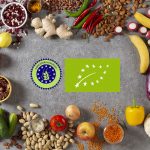
- The EU organic logo (the green leaf).
- The control body code (e.g., ES-ECO-XXX-XX).
- Origin indication: “EU Agriculture”, “Spain Agriculture”, etc.
Remember:
You cannot use terms like “bio” or “eco” unless you are certified. These are legally protected.
Common mistakes:
- Forgetting the control body code.
- Incorrectly indicating the origin.
- Use ambiguous terms that could lead to confusion.
🔁 8. Mandatory annual controls
Certification is not indefinite.
Each year you will have:
- At least one regular inspection.
- Possible surprise inspections.
- Document review.
- Sampling if applicable.
If you fail to comply with the regulations, they may:
- Suspend your certificate.
- Withdraw it.
- Impose financial penalties.
💰 9. Indicative costs
The cost depends on:
- Size of the farm.
- Type of activity.
- Autonomous Community.
- Certification body.
In general:
- Registration fee.
- Annual certification fee.
- Additional cost for expansions or modifications.
👉 Many communities offer aid within the CAP for organic production.
📊 10. Real advantages of certification
Beyond regulatory compliance, organic certification allows:
- Access to specialized markets.
- Better brand positioning.
- Higher prices in many cases.
- Consumer trust.
- Possibility of export within the EU.
Spain is one of the countries with the largest organic surface area in Europe, demonstrating that the system works and that the market continues to grow.
✅ Final checklist to obtain your organic certification
✔️ Study Regulation (EU) 2018/848 ✔️ Identify the autonomous authority ✔️ Submit application and registration ✔️ Prepare report and documentation ✔️ Adapt production practices ✔️ Pass initial inspection ✔️ Obtain certificate ✔️ Comply with annual controls
🌿 Conclusion
Obtaining organic certification in Spain is not a superficial process: it is a technical, documentary, and productive commitment. However, with good planning, proper advice, and organized documentation, the process is perfectly manageable. The key is to understand that it is not just about stopping the use of chemicals, but about implementing a comprehensive controlled and traceable production system. In our Allotarra store 👉 all products are organic with guarantee seals